
The most practical way to start online earning in Pakistan is to choose work you can deliver, verify how you will get paid, and test the route before spending money.
Freelance services, remote jobs, tutoring, selling, content creation, and small tasks suit different skills and schedules. This guide helps you compare those options, check the risks, and follow a 30-day test plan.
No route guarantees income. Results depend on your skills, demand, effort, and access to payment.
Choose the kind of online work that fits you

The choice gets easier when you compare fit, time, and payment access.
Freelance services and remote jobs suit people ready to show skills. Tutoring works when you can teach a subject, while selling requires a product and a clear cost plan.
Content creation takes time to build an audience. Surveys and microtasks are smaller experiments, so check eligibility and payout terms before signing up.
Use this comparison to narrow your choice. The first proof is a starting task you can complete; it is not a forecast of income or time to a paid opportunity.
| Route | Useful first proof | Check before committing |
|---|---|---|
| Freelance services | A sample solving one specific customer problem | Scope, revisions, fees, and agreed payment milestones |
| Remote employment | A relevant CV and a tailored application | Employer identity, Pakistan eligibility, hours, and equipment |
| Online tutoring | A short lesson outline for a defined student need | Subject knowledge, scheduling, platform rules, and payment |
| Online selling | A product listing and a complete cost calculation | Delivery, returns, platform charges, and margin after costs |
| Content creation | A small set of useful posts for one audience | Publishing effort and the provider’s monetization requirements |
| Surveys and microtasks | A record of time spent and a verified small withdrawal | Task availability, data requested, withdrawal minimums, and fees |
Freelance a service you can deliver
Start with a service you can demonstrate.
Freelancing means doing a defined piece of work for a client. Examples include graphic design, video editing, writing, bookkeeping, web development, translation, virtual assistance, and social media support.
You do not need to master every tool. You do need to solve a specific problem reliably, and a focused sample helps clients judge your work.
Start with one service and one kind of customer. “I edit short videos for local restaurants” is easier to understand than “I can do anything online.”
Make two or three sample projects that demonstrate the work.
Use fictional or self-initiated briefs if you have no clients yet, and label them as samples. Never present practice work as paid client experience.
Marketplaces such as Upwork can help clients and freelancers find one another, but they do not guarantee work.
Read the platform’s current freelancer fee information before pricing a contract; fees and terms can vary.
You can also approach businesses directly, provided your messages are relevant and respectful.
Agree on scope, deadline, revisions, price, and payment milestones in writing before beginning.
Apply for remote or part-time jobs
A remote role may suit you if you prefer set responsibilities and an employer’s hiring process.
Search for specific titles, such as customer support representative, junior designer, or QA tester, instead of relying on broad “online jobs” listings.
Then check the location, hours, equipment, language, and experience requirements. Remote work may still exclude some countries or time zones, so confirm Pakistan eligibility before applying.
Prepare a concise CV and a short note tailored to the role. Research the employer through its official website and a second reliable source.
Be cautious if a supposed employer asks you to pay a recruitment, training, or equipment fee to secure a job, or requests sensitive identity or bank details before you have verified who they are and why the information is needed.
Teach online
If you know a subject well, online tutoring or lessons may be an option.
First identify who you can teach, what outcome a lesson helps them reach, and whether you meet the platform’s age, qualification, and location requirements.
A short sample lesson or clear syllabus helps a prospective student assess your offer.
If teaching does not fit, you may prefer selling a product or building an audience.
Sell products or build an audience
Online selling can involve physical products, digital downloads, or a service packaged as a product.
Before pricing, calculate materials, delivery, platform charges, returns, and the time you will spend serving customers.
Content creation can build an audience, but monetization takes time and depends on eligibility. Treat it as a long-term project, not a predictable first-month paycheck.
Treat surveys, microtasks, and reward apps as limited experiments
Surveys, microtasks, and reward apps can be easy to try, but the rules vary.
Availability, qualification, withdrawal minimums, and payment methods depend on the service and country. A task appearing in an app may not be available to every user in Pakistan or pay enough to replace regular work.
Before sharing information or investing time, read the official terms and privacy policy, check current payment rules, and look for independent user reports.
Keep a simple record of time spent, completed tasks, fees, and any amount actually received. That lets you calculate your effective hourly return.
If an app requires a deposit, pressures you to recruit friends, or makes withdrawal depend on repeated top-ups, stop and investigate instead of paying more to recover a balance.
For online earning in Pakistan, count only payments you have actually withdrawn.
Start with one offer, not ten apps
When you are new, a focused experiment teaches more than signing up for a dozen platforms at once.
Pick one route for the next month and write down what success would look like beyond money: a completed portfolio sample, five suitable applications, a first tutoring session, or a verified small payout. These are milestones you can control while you learn how the market works.
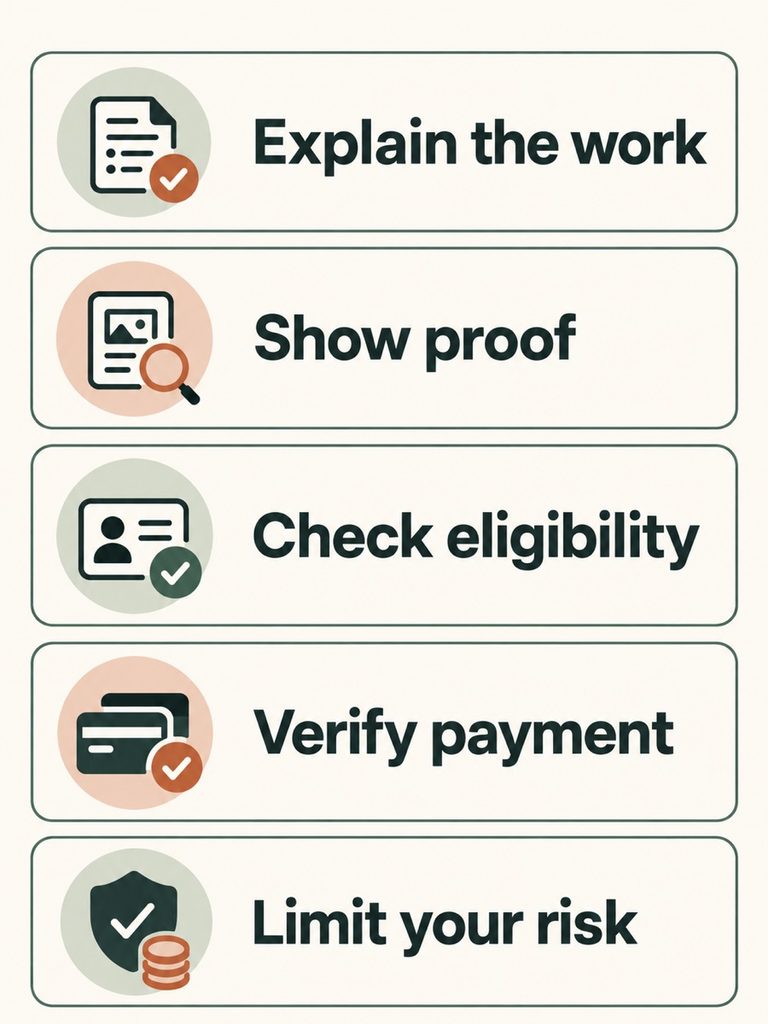
Use this quick filter before committing:
- Can you explain the work? Describe the task or service in one sentence.
- Can you show proof? Prepare a sample, qualification, product photo, or clear profile.
- Can you participate? Check the provider’s current age, location, identity, and account requirements.
- Can you receive payment? Confirm supported withdrawal routes, minimums, fees, conversion, and processing times from official sources.
- Can you afford the downside? Avoid borrowing or paying for access based on an income promise.
For services, calculate a minimum acceptable project price from your estimated hours, revisions, platform costs, and delivery expenses.
For a job, verify the employer and role.
For an app or task site, test only with time you can afford to lose and do not treat an unwithdrawn in-app balance as money received.
A practical 30-day plan
Once you choose a route, the next step is to test it on a small scale.
A short cycle of choosing, preparing, testing, and reviewing can show whether it deserves more effort. Keep the steps small enough to fit around study, family responsibilities, or your current job.
If the first approach falls short, use what you learned to adjust the offer or try another route. One weak test does not prove every opportunity is a scam, and it does not mean every opportunity will pay.
Week 1: Pick a route and check the rules
List your skills, tools, available hours, and any subjects or products you can credibly offer. Choose one route.
Read its current eligibility and payment terms on the provider’s own website. Write down startup costs, recurring fees, payout thresholds, and equipment or internet costs.
If the information is unclear, contact the provider through its official channel or choose a clearer option.
Week 2: Build a small proof of work
Create a sample that resembles the work you want.
A designer might produce a small set of social graphics; a writer might prepare a short, researched sample; a tutor might record a short lesson outline; a seller might test product photos and delivery costs.
Ask one or two people in the intended audience what is confusing or useful. Make a specific improvement before you start pitching.
Week 3: Reach real prospects
Prepare a short profile or application that explains the customer’s problem, what you will deliver, and how long it will take.
Apply only to relevant roles or send a small number of tailored client messages. Avoid copying the same generic pitch to hundreds of people.
Keep records of applications, replies, interviews, trial tasks, and agreed terms. Do not do substantial unpaid work as a “test” without a clear reason and boundaries.
Week 4: Review evidence and choose the next step
Look at what happened: Did anyone respond? Which samples got interest? Did you complete work to the agreed standard?
If you used an app, could you withdraw through a verified route, and what was your actual return after time and costs?
Continue if the evidence is encouraging and the work is sustainable. Otherwise adjust one variable, such as your offer, sample, target customer, or route, and test again.
Protect your money, time, and personal information
Legitimate work can still involve fees, delays, and disputes, so check the details before sharing information or doing substantial work.
Online scams often try to rush people into a decision or make earnings appear guaranteed. A polished website or a large social-media following is not proof that an offer is safe.
Verify the company, read the terms yourself, and keep copies of agreements and payment records. For safer online earning in Pakistan, confirm the source of income and payment rules first.
Slow down if you see any of these warning signs:
- A guaranteed daily or monthly return with little work, especially when no clear customer or product explains where the money comes from.
- A required deposit, “activation” payment, or repeated top-up to unlock tasks or withdraw earnings.
- Pressure to recruit friends as the main way to make money.
- Requests for passwords, one-time codes, or identity documents through an unverified chat account.
- A job offer with no interview or credible employer details, followed by a request for money or bank access.
- Withdrawal rules that keep changing after you reach the stated minimum.
Use unique passwords and turn on two-factor authentication where available. Share only the information needed for a verified purpose.
For cross-border work, confirm payment method, conversion charges, withdrawal requirements, and your own tax or legal obligations from current official sources or a qualified professional. This guide is general information, not personal financial or legal advice.
What about training and paid courses?
Training can help when it teaches a specific skill, includes useful practice, and fits your budget.
Before paying, check the syllabus, instructor experience, student support, refund terms, and whether the same material is available from a trusted free source.
Do not borrow money or rely on testimonials as proof that you will earn a particular amount.
Next Age Solutions offers GBOB training about guest-blogging outreach as a service.
This is our own course, so consider it as one optional learning route, not a job offer or a promise of clients or income.
Review the current course scope, price, and terms directly before deciding. You can also begin by learning from free resources and building a sample before spending money.
Frequently asked questions
Can I start online earning in Pakistan without investment?
You can begin some routes without paying for a course or app, especially if you already have internet access and a device.
“No investment” does not mean no cost: time, data, electricity, equipment, and platform charges may still apply. Start with an option whose costs and rules you understand.
Which online earning method is best for beginners?
There is no single best method for everyone.
A person with a useful service and sample work might test freelancing; someone who prefers structured employment may apply for remote roles; a strong subject teacher might try tutoring.
Compare fit, eligibility, costs, payment access, and realistic time to a first opportunity.
Can earning apps provide a full-time income?
Some apps offer paid work or rewards, but an app’s presence in an app store does not establish that it provides reliable full-time income. Compare eligibility, work types, fees, and payout checks in our earning apps guide for Pakistan before you decide.
Verify its current tasks, eligibility, withdrawal terms, and actual payment evidence. Treat casual surveys and reward tasks as supplemental unless you have strong evidence that the work is stable and worthwhile.
How long does it take to earn your first money?
There is no dependable timeline. It depends on your skills, the route, demand, competition, your availability, and payment processing.
Set early goals you can control, such as completing a sample or making a set of tailored applications, then judge the route by actual responses and received payments.
The sensible way to begin
Choose one path that matches something you can do or learn, verify the rules and payment route, and make a small piece of proof.
Then test your offer with real employers, clients, students, or users. Track both time and money, and keep your expectations tied to evidence.
That is a steadier way to explore online earning in Pakistan than chasing whichever app or opportunity makes the biggest promise.